


December 31, 2025 | Articles
Abdullah Alnabhan Joins Hill International as Managing Director, Middle East

As of September 2025, construction is approximately 45% complete on the Santa Clara Valley Transportation Authority’s (VTA) $600 million Eastridge to BART Regional Connector in East San Jose, California. Scheduled for completion in 2027, the project is extending VTA’s Orange Line 2.4 miles from the existing Alum Rock Light Rail Station to the Eastridge Transit Center via an elevated guideway located primarily in the center of Capitol Expressway. The project will also deliver two power substations and two new stations, including an elevated station at Story Road and an at-grade station located at the Eastridge Transit Center.
The light rail extension is Phase 2 of VTA’s Capitol Expressway Transit Improvement Project. Phase 1 involved sidewalk, lighting, and landscaping improvements along the project corridor to increase safety for pedestrians and cyclists, as well as the reconstruction of the Eastridge Transit Center to promote user convenience and comfort and accommodate bus rapid transit service. Phase 1 construction concluded in 2015.
“When the Regional Connector is complete, VTA and intercity bus passengers will be able to board light rail at the Eastridge Transit Center and connect with VTA’s entire rail system,” explains Vice President Ray Balallo, PE, who leads Hill International’s construction management team on the project. “This will also connect them to the BART system, and so the whole of the Bay Area, at Milpitas Station. Likewise, light rail passengers will have increased access to locations throughout East San Jose via bus connections at Eastridge.
“By tying together multiple transportation systems, the project drives transit utilization and promotes mobility throughout the region. Increased mobility connects people to job centers and contributes to economic opportunities, while increased transit utilization reduces traffic, which makes our streets safer, and cuts greenhouse gas emissions, supporting regional environmental goals and resident health and wellness.”
Construction Updates & Community Engagement
In addition to Hill, VTA’s project team includes the MCM-Railworks Joint Venture as the prime contractor and several additional consulting firms. MCM brings civil and elevated guideway expertise, while Railworks takes the lead on light rail components. This complementary expertise allows for schedule savings and helps ensure quality throughout construction.
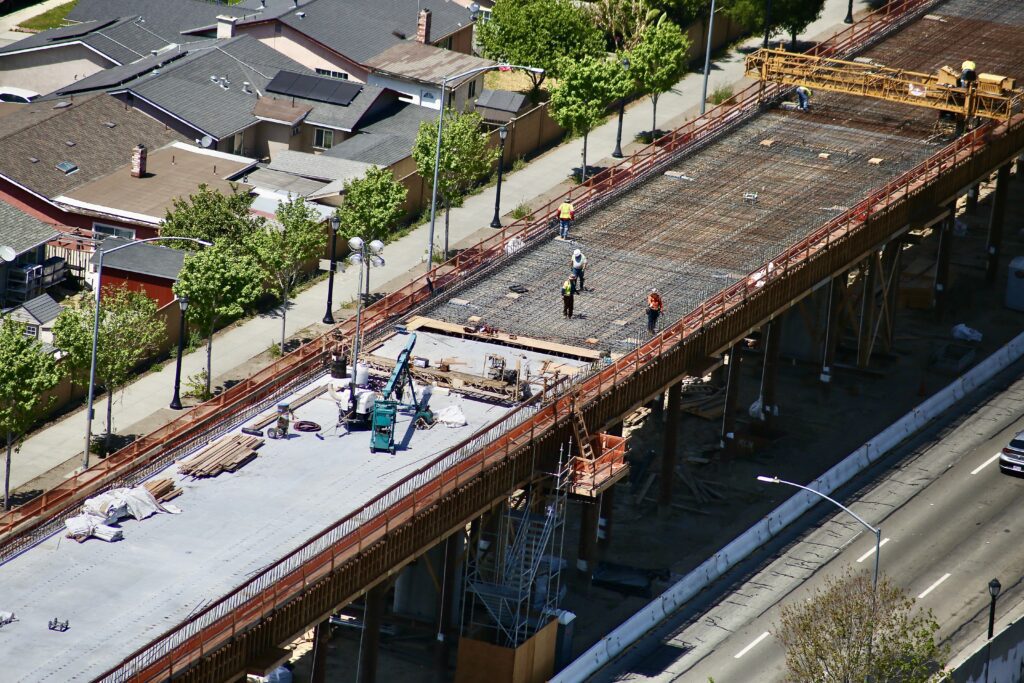
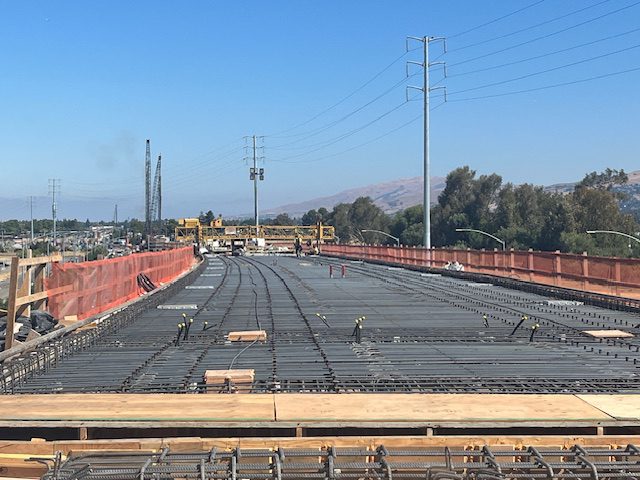
The project team continues to build the elevated guideway structure and prepare mockups prior to the installation of rail on completed sections of the guideway’s concrete deck. Ongoing construction activities include pile driving, concrete footing pours, falsework installation, and more. Because the guideway is located primarily in the center of Capitol Expressway, an arterial roadway and transit corridor, and because the project involves a variety of intensive, 24/7 construction activities taking place simultaneously with heavy equipment and large crews, the project team is also working hard to promote safety for workers, pedestrians, bicyclists, and motorists.
“Safety is the team’s top priority,” says the project’s Community Engagement Officer Lupita Franco Peimbert. “Especially during the school year, there is heavy car and foot traffic in the area. We have posted plenty of traffic signs alerting drivers to construction activities, detours, lane closures, new traffic patterns, and other restrictions.”
According to Lupita, the team is coordinating with the San Jose Police Department to help ensure drivers comply with the posted signage. “Additionally, crossing guards are present at intersections in the project area, and we’re in contact with local schools to inform parents about construction activities and any traffic impacts,” she adds.
In addition, the project team maintains a regular construction newsletter, posts updates on VTA’s website and social media accounts, sends mailers to residents in the project area, hands out flyers door-to-door, and interfaces with the community through a variety of in-person and virtual forums. Conducted in multiple languages, this outreach helps keep residents and travelers informed about project progress and traffic updates, as well as expected noise, dust, and vibration levels.
Aligning Inputs With VTA’s One-Team Culture
To accomplish a complex transit expansion while delivering accurate communications that reach the right stakeholders at the right time is no easy feat, says Ray. “VTA has built a highly capable project team,” he adds. “However, to prevent cost escalation, schedule slippage, safety incidents, and community dissatisfaction, it is extremely important to keep the inputs of every team member and many project stakeholders in alignment. The key to our success so far has been VTA’s ‘one-team’ culture.”
The one-team culture shapes the team’s approach to a variety of project challenges. It starts with commitment to a shared definition of project success. Then, the project team works towards common goals.
For example, one of the project’s commitments is to minimize community impacts related to noise, dust, and vibrations during construction. The prime contractor leads construction activities in line with best practices for reducing noise, dust, and vibrations, but VTA takes ultimate responsibility for the outcomes. The project team works with the VTA community outreach and public engagement team and communications consultants to provide timely notice to community stakeholders. While construction is underway, noise, dust, and vibration levels are monitored and reported to VTA’s management team. Based on the field reports, the management team can issue updated notices, work with the project team to further reduce levels, and/or coordinate with the community to answer questions and respond to concerns. As VTA’s construction management consultant, Hill is responsible for tracking and reporting on each team member’s inputs throughout the process, giving VTA timely data to facilitate continued team alignment and initiate corrective action as necessary.
“This is how a one-team culture works,” Ray adds. “With our shared definition of project success, we can better collaborate to keep information flowing, coordinate and execute work activities, refine processes, mitigate risk, and keep stakeholders informed. With an atmosphere of partnership and mutual respect, the team is not pointing fingers when challenges arise. Instead, we’re all asking what we can do in service of the project. The Hill team looks forward to working with our partners to maintain this culture and deliver VTA’s transformative project for San Jose.”
To learn more about the Regional Connector and the project’s one-team culture, contact Ray Balallo at [email protected]. To learn more about Hill International’s work on rail and transit projects around the world, please visit https://www.hillintl.com/rail-transit-practice/.
Photo credit: VTA’s Eastridge BART Regional Connector Team
Share
December 31, 2025 | Articles
Abdullah Alnabhan Joins Hill International as Managing Director, Middle East

December 15, 2025 | Articles
Progressive Design-Build Powers Poulsbo’s New Fire Station 76

December 8, 2025 | Articles

December 4, 2025 | Articles
Hill International Helps Deliver National Museum in Abu Dhabi

November 12, 2025 | Articles

November 3, 2025 | Articles
Hill International to Support High-Efficiency Gas Cogeneration Projects in Bucharest

October 12, 2025 | Articles
An Interview With Pakistan Country Manager Syeda Fakhar-un-Nisa

October 5, 2025 | Articles
More Than a Park: The Latest Updates on PennDOT’s I-95 CAP Project in Philadelphia

